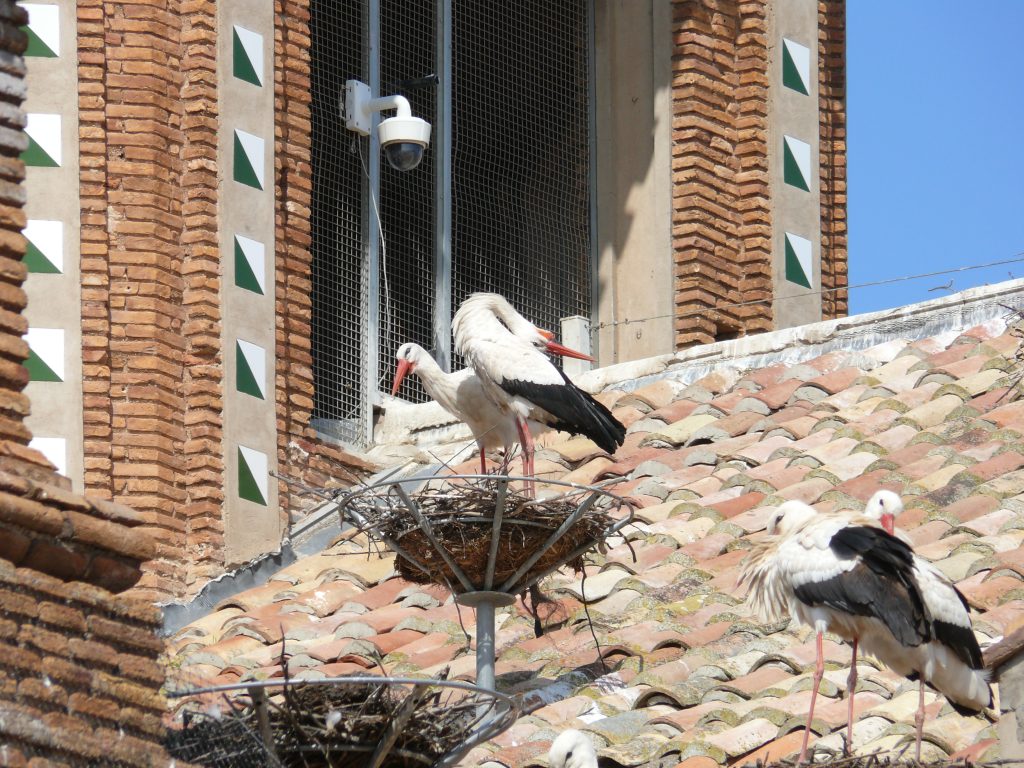
3 February is – for those who celebrate – the first day of spring. At least it is in Spain, where this is the day you expect to see the first white storks returning from their wintering grounds in Africa.
Por san Blas, la cigüeña verás; Si no la vieres, año de nieves. Come San Blas Day, storks on their way; if they don’t show, winter of snow.
Traditional
It was probably never true: storks leave Spain early and return early – the first few cross the Strait of Gibraltar and arrive back from Africa before Christmas. Nowadays, though, fewer and fewer Spanish storks migrate at all. Adult birds, at least, have learned that with climate change, coupled with the availability of easy food at garbage dumps, it is better to spend the winter in Europe than to risk the desert crossing over to sub-Saharan Africa. Young birds still have a strong migratory instinct, until they return after two years away and hang around with more experienced birds.
My favourite fact about storks: in Spain, the sound of their bill-clattering display – which is what the bird in the centre of the picture is doing – is so familiar as it echos off church walls in hundreds of villages and towns across the country, that it has its own word with no other meaning – crotoreo.
Ten years ago, I was in Spain for San Blas Day at the start of what was to be my ‘Long Spring’. Four months later, I arrived at the northern edge of the continent in Arctic Norway. I had travelled in a series of short journeys through six countries, tracking the arrival of spring as it spread north. My book The Long Spring was published two years later. Now, it is almost sold out and a tenth anniversary new edition is on its way – due in March. I’ll post a blog every week or so – stories from the front edge of Spring 2016.
The last few copies of The Long Spring first edition are available at a clearance discount here, while stocks last.
Browse other articles relating to the one you've just read.
February 19, 2026
The Cranes’ Journey
As part of my blog series The Long Spring - ten years on, I recall the first appearance of a bird that was to accompany me for virtually the whole of the rest of my journey, all the way to the far north of Norway.
To mark the publication on Monday of Framing Nature - conservation and culture, this long-read essay compiles edited excerpts on the subject of extinction and loss